



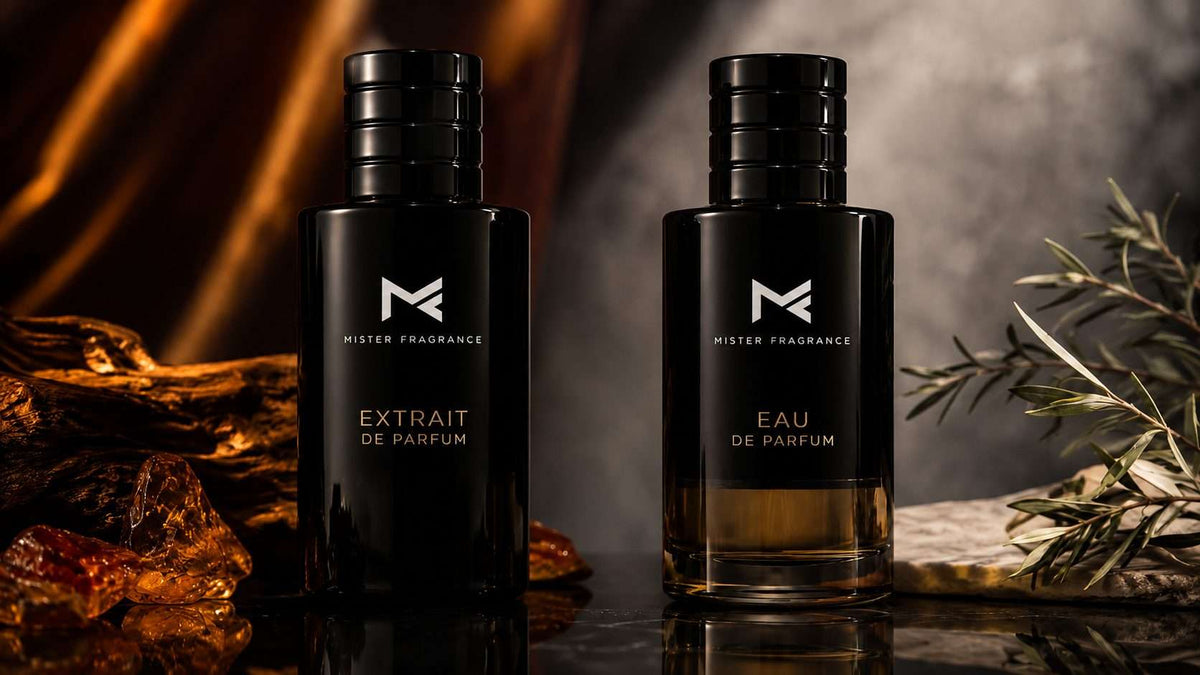
If you've been comparing options online, you'll have seen Eau de Parfum and Extrait de Parfum on labels, often with very different price tags. Both describe fragrance concentration, and understanding what that means is the most useful thing you can do before you buy.
This guide explains the practical differences in plain English, including why every fragrance we make at Mister Fragrance is an Extrait de Parfum.
Fragrance Oil Concentration

Extrait de Parfum generally contains a higher fragrance oil concentration than Eau de Parfum, although exact percentages vary by manufacturer and there is no legal standard.
Every fragrance blends fragrance oils, which create the scent, with a carrier, usually alcohol, which helps it spread and evaporate on the skin. Concentration describes how much of the bottle is made up of those oils. The industry typically recognises these ranges:
|
Fragrance Type |
Typical Fragrance Oil Concentration* |
|
Eau de Cologne |
Around 2 to 5% |
|
Eau de Toilette |
Around 5 to 15% |
|
Eau de Parfum |
Around 15 to 20% |
|
Extrait de Parfum |
Around 20 to 40% |
Extrait de Parfum sits at the top of that scale. Every Mister Fragrance scent is blended at approximately 35 to 40% fragrance oil, at the premium end of the category, and you'll find that figure printed on every bottle.
More oil generally means a richer, denser scent, but concentration isn't everything. The quality of the raw materials and how well a fragrance is composed matter just as much. It's why we don't rush production: every batch is blended in-house in Manchester from premium raw materials, mixed for 25 minutes into a smooth oil, quality checked under its own batch number, then left to macerate for three to four weeks before bottling so the scent settles properly. We chose Extrait de Parfum because the format gives our luxury-inspired scents the depth to feel genuinely premium without the designer price attached.
Longevity
A higher fragrance concentration can contribute to longer wear, but longevity also depends on ingredients, skin chemistry and application.
As a rough guide, many Eau de Parfums give several hours of wear before needing a top up, while an Extrait de Parfum can often see you through a working day on fewer sprays. Lasting power is the theme customers mention most in our five-star Trustpilot reviews, but nothing is guaranteed: bright citrus notes tend to fade sooner than woods, amber, vanilla or resins regardless of concentration, and your skin type, the weather and where you apply all play a part.
Two misconceptions worth clearing up: concentration alone doesn't decide longevity, and applying more sprays doesn't reliably make a fragrance last longer. Extra sprays mostly increase the opening intensity.
To get the most from any fragrance:
-
Apply to clean, moisturised skin.
-
Focus on pulse points such as the neck and wrists.
-
Avoid rubbing your wrists together.
-
Store bottles away from heat and sunlight.
Scent Strength and Projection
Higher concentration does not always mean a fragrance projects further, but it can create a richer, more rounded scent experience.
Projection is how far a fragrance radiates from your skin. Sillage is the trail it leaves as you move. Counterintuitively, an Eau de Parfum often opens louder, with a bright initial burst that fills the space around you, while an Extrait tends to sit closer to the skin, trading that opening blast for depth that people notice up close.
Neither is right or wrong. In an office or in meetings, a more personal scent bubble is often preferable to something attention-grabbing. If you want to be noticed the moment you walk in, a punchier opening may appeal.
Scent Development on the Skin
Extrait de Parfum and Eau de Parfum can evolve differently throughout the day depending on their composition.
Most fragrances are built as a pyramid. Top notes are the first impression, usually fresh and fleeting. Heart notes emerge as the opening fades and define the character. Base notes (woods, amber, musk and vanilla) form the lasting foundation closest to the skin. With more alcohol in the mix, an Eau de Parfum tends to open brightly and move through its stages quickly. An Extrait, weighted towards the heart and base, generally develops more slowly and stays truer to its core.
Skin chemistry adds a final twist: the same fragrance can smell noticeably different from one person to the next, so give a new scent time to settle before judging it. It's one reason our men's inspired aftershaves lean into rich, base-heavy compositions that settle into the skin rather than sitting on top of it.
How Much You Need to Apply
The ideal number of sprays depends on the fragrance and occasion rather than concentration alone.
For the office, one or two sprays to the pulse points keep the scent within your personal space. Everyday wear suits two or three. Evenings can take a spray or two more, particularly in cooler weather. In summer heat, less is more, as warmth amplifies fragrance. With an Extrait de Parfum, start at the lower end of each range. The richness means a little goes a long way, and you can always build up once you know how it performs on your skin.
Value for Money
Value isn't simply about bottle price. It depends on performance, usage and how often you wear the fragrance.
Think in cost per wear rather than cost per bottle. If an Extrait needs two sprays where a lighter fragrance needs four, the bottle lasts roughly twice as long, which can make a higher upfront price the cheaper option over time. If you're buying one signature bottle, choose something versatile enough for work and weekends. If you're building a fragrance wardrobe, smaller bottles let you rotate scents by season without a big outlay.
If you're unsure, sample first. A small trial size lets you judge longevity, projection and how a scent behaves on your skin before committing, and helps you avoid the disappointment of a blind buy. It's why we offer every fragrance in a 3ml trial size as well as full bottles.
Which Should You Choose?
Choose the concentration that best suits how and when you wear fragrance rather than assuming one is automatically superior.
|
If you... |
Consider... |
Why |
|
Wear fragrance daily |
Extrait de Parfum |
Fewer sprays per wear improves cost per wear |
|
Want one signature scent |
Extrait de Parfum |
Depth and staying power suit an everyday signature |
|
Prefer lighter fragrances |
Eau de Parfum |
Brighter, airier compositions suit a fresher style |
|
Enjoy evening fragrances |
Extrait de Parfum |
Richer scents come alive in cooler evening air |
|
Want maximum versatility |
Either |
Rotating scents by occasion gives flexibility |
|
Are buying without smelling first |
Samples |
Your own skin is the most reliable test |

What To Remember
Extrait de Parfum generally offers a higher oil concentration, a richer scent and longer wear from fewer sprays. Eau de Parfum offers a brighter, more diffusive style. Concentration is only part of the picture: composition, ingredient quality and your own skin all shape performance. That balance of depth and value is why we chose Extrait de Parfum for every fragrance we make. One note on honesty: our fragrances are interpretations inspired by well-known scents, not replicas, and we have no affiliation with the original brands.
Now that you understand the difference between Eau de Parfum and Extrait de Parfum, explore our men's extrait de parfum products to find a fragrance that suits your style.


